In the last day, Shiba Inu is experiencing a dramatic decline in on-chain activity as exchange outflows are below one billion $SHIB. It clearly indicates that this level is a loss of momentum across the network, as it does. This kind of slowdown is not a neutral development for an asset that depends on retail participation and continuous circulation.
Rapid exchange withdrawals
In most exchanges, token withdrawals are known as outflow (and often refer to accumulation/long term holding practices) and are commonly associated with long-term or aforementioned. Assuming outflows are increasing, investors are removing the supply from the market during bull markets, which lower pressure to sell right away. However, this situation is the opposite outflows are falling because of a decline in activity rather than investor confidence.
$SHIB/USDT Chart by TradingView
$SHIB/USDT Chart by TradingView
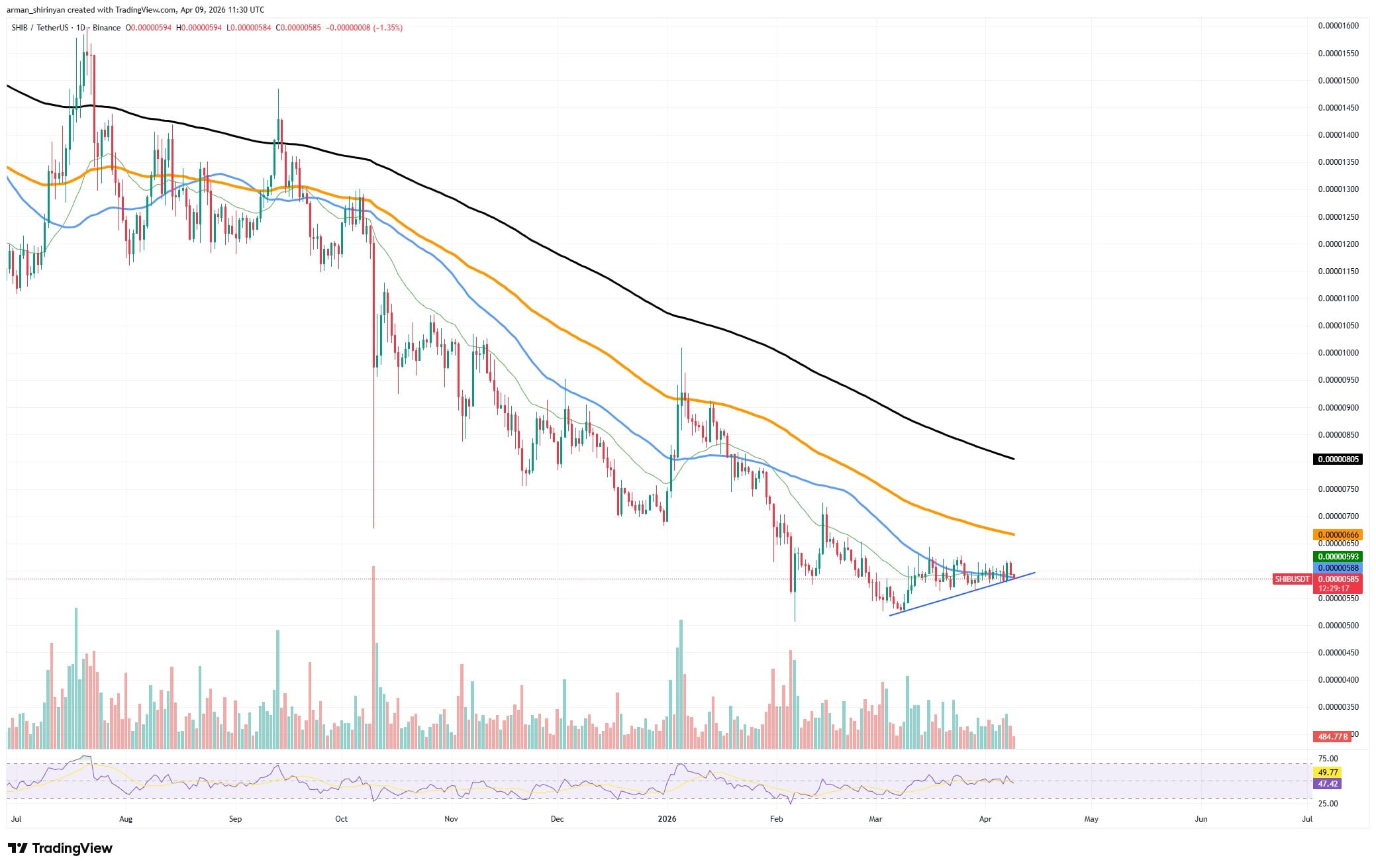
This slack does not reflect $SHIB on the price chart. After a long downtrend, the asset has entered ‘low consolidation phase’ and formed sloping ascending structure after forming. Despite the fact that higher lows may initially seem positive, overall picture is negative. $SHIB still has Key moving averages, which are all continuing to trend downward and cap upside attempts.
Shiba Inu’s lack of substance
There are no outflows, which is consistent with waning conviction. Despite investors’ declining distribution of high-profile investments, the investor is also not aggressively building up money. Instead, the market is in a low-energy state with little involvement.
This usually comes before a rise in volatility or the continuation of the current trend, which is often preceded by an increase in . Given the structure, it is still more likely that a downward path will be taken.
The low outflows of $SHIB also reduce one of the few supporting mechanisms that it has developed. But if tokens are not consistently removed from exchanges, supply is still readily available to allow selling pressure to return. That is why any recovery effort that could be reformed (especially in an economy where liquidity is already distributed) has been weaker.
But the current stabilization should not be interpreted as accumulation; $SHIB does not indicate any signs of strong demand returning. Any upside is risky until outflows and overall activity dramatically increase, but any negative side of are dangerous. It’s not disintegrating at this stage, but $SHIB is also weakening as it does not re-incorporate. It is just fading, which is often more dangerous than making a quick move.
Thanks for reading Less Than One Billion Shiba Inu (SHIB) in 24 Hours: Outflows Plummeting
